Introduction
Healthcare is an industry built on data—from patient histories and diagnostic imaging to laboratory results, claims files, and operational metrics. Yet for decades, much of this data remained untapped, isolated in fragmented systems and unstructured formats. The digital transformation of healthcare, combined with the rise of analytics and machine learning, has unlocked a new era where data becomes actionable intelligence.
Healthcare data analytics refers to the systematic examination of medical, operational, and financial data to improve patient outcomes, optimize workflows, and support value-based care. This article explores what healthcare analytics is, how it works, why it matters, and how organizations are using it to transform both clinical and administrative performance.
===========================================
1. What Is Healthcare Data Analytics?
===========================================
Healthcare data analytics involves applying statistical techniques, predictive modeling, and data mining to healthcare information. Its purpose is to uncover trends, identify patterns, and support decisions across clinical, financial, and operational domains.
Analytics can be applied to a wide array of data sources, including:
- Electronic Health Records (EHRs)
- Medical imaging
- Laboratory systems
- Claims data
- Pharmacy records
- Wearable device data
- IoT healthcare devices
- Population health databases
- Patient-reported information
The result is a deeper, more holistic understanding of both individual patients and broader populations.
===========================================
2. Types of Healthcare Analytics
===========================================
Healthcare analytics is typically categorized into four main types, each serving a different purpose in the decision-making process.
1. Descriptive Analytics — Understanding What Happened
Descriptive analytics answers questions like:
- What were last month’s admission rates?
- What percentage of heart failure patients were readmitted?
- How many imaging studies were performed this quarter?
It summarizes historical data to make trends and patterns visible.
2. Diagnostic Analytics — Understanding Why It Happened
Diagnostic analytics digs deeper by analyzing:
- Correlations
- Variances
- Root causes
Example:
If a hospital saw an unexpected rise in postoperative infections, diagnostic analytics could identify contributing factors such as:
- Staffing shortages
- Surgical instrument delays
- Non-adherence to protocols
3. Predictive Analytics — Understanding What Will Happen
Predictive analytics uses machine learning and statistical algorithms to forecast outcomes such as:
- Readmission risk
- Sepsis likelihood
- Length of stay
- Disease progression
- Patient flow demands
These insights help clinicians and administrators anticipate problems before they arise.
4. Prescriptive Analytics — Understanding What Should Be Done
This is the most advanced type of analytics. It recommends actions based on predictive models.
Examples:
- Suggesting optimal staffing levels
- Recommending personalized treatment plans
- Optimizing supply chain decisions
Prescriptive analytics drives proactive, rather than reactive, healthcare management.
===========================================
3. Why Healthcare Data Analytics Matters
===========================================
Analytics has become essential to modern healthcare, and its impact spans multiple areas of care delivery.
1. Improving Patient Outcomes
Healthcare analytics enhances outcomes by:
- Detecting diseases earlier
- Predicting risk and preventing complications
- Supporting evidence-based treatment
- Monitoring chronic diseases more effectively
Clinicians gain clarity, and patients receive more precise care.
2. Enabling Personalized and Precision Medicine
Analytics helps tailor treatments using:
- Genetic data
- Lifestyle information
- Clinical history
- Medication response patterns
Personalized medicine reduces trial-and-error care and improves therapeutic effectiveness.
3. Reducing Medical Errors
Medical errors often stem from:
- Oversights in documentation
- Misinterpreted data
- Missed abnormalities
- Poor coordination
Analytics flags anomalies and assists clinicians with real-time alerts, reducing risk and enhancing patient safety.
4. Enhancing Operational Efficiency
Administrators use analytics to:
- Optimize scheduling
- Reduce wait times
- Improve bed utilization
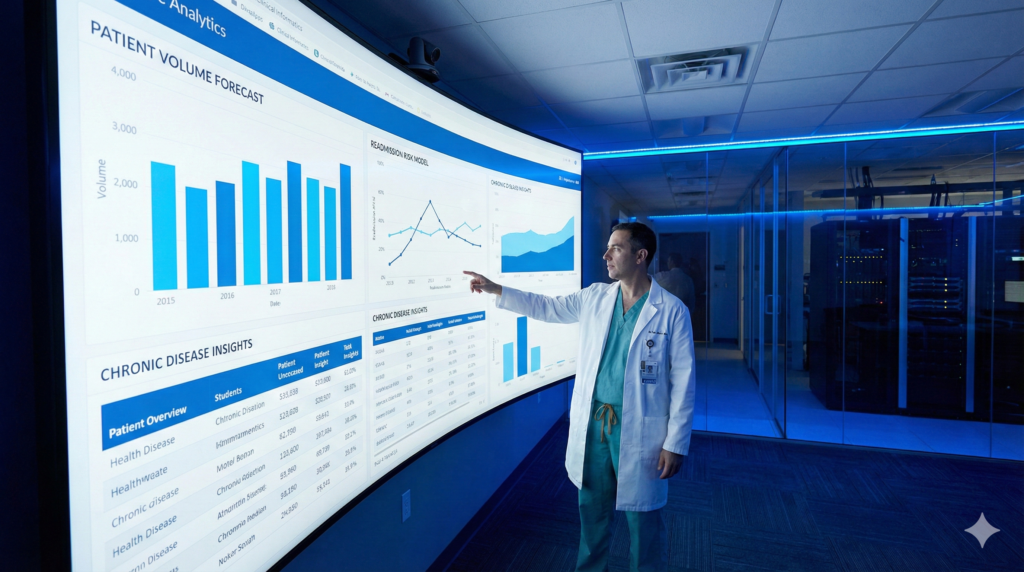
- Forecast patient volumes
- Balance staffing levels
This leads to smoother workflows and improved patient satisfaction.
5. Supporting Value-Based Care Models
Healthcare is shifting from fee-for-service toward value-based care, which rewards:
- Better outcomes
- Lower costs
- Improved patient experience
Analytics supports:
- Quality reporting
- Population health management
- Risk adjustment for reimbursement
Without analytics, value-based care cannot succeed.
===========================================
4. Key Use Cases of Healthcare Data Analytics
===========================================
Analytics has practical applications across nearly every aspect of healthcare.
1. Readmission Prevention
Predictive models identify patients most likely to be readmitted and help design targeted interventions.
2. Chronic Disease Management
Analytics tracks long-term data trends for conditions like:
- Diabetes
- COPD
- Heart failure
- Hypertension
Early detection of worsening trends helps prevent hospitalizations.
3. Emergency Department Optimization
Real-time analytics:
- Predicts patient arrival surges
- Prioritizes high-risk patients
- Helps manage staffing in busy EDs
This reduces crowding and improves emergency care delivery.
4. Population Health and Public Health Monitoring
Analytics helps organizations:
- Identify high-risk communities
- Track vaccination rates
- Understand disease spread
- Design preventive care strategies
This makes healthcare systems more resilient and better prepared for crises.
5. Financial Performance Management
Organizations use analytics to:
- Identify denial trends
- Improve reimbursement rates
- Reduce operational waste
- Forecast service demand
This strengthens financial sustainability.
===========================================
5. The Role of Machine Learning in Healthcare Analytics
===========================================
Machine learning models significantly elevate the accuracy and value of analytics.
1. Predictive Risk Models
These models analyze clinical, demographic, and behavioral data to predict:
- Mortality risks
- Complication likelihood
- Admission or readmission probability
2. Natural Language Processing (NLP)
NLP extracts meaning from unstructured data such as:
- Doctor’s notes
- Radiology narratives
- Pathology reports
- Patient messages
This unlocks insights hidden in text-based documentation.
3. Advanced Pattern Recognition
AI systems detect patterns humans might miss, such as:
- Micro-lesions in imaging
- Abnormal biomarker trends
- Hidden correlations across datasets
This improves care precision and diagnostic accuracy.
===========================================
6. Challenges in Implementing Healthcare Analytics
===========================================
While analytics offers significant benefits, healthcare organizations face several challenges.
1. Data Fragmentation
Patient data is often stored in:
- Multiple EHR systems
- Separate lab databases
- Scattered imaging tools
Integrating these systems is essential.
2. Data Quality Issues
Incomplete, inconsistent, or inaccurate data undermines analytics and AI models.
3. Privacy and Security Requirements
Organizations must comply with:
- HIPAA
- GDPR
- Data encryption standards
- Access control measures
Data breaches can have severe consequences.
4. Shortage of Skilled Personnel
Healthcare often lacks:
- Data scientists
- Analysts
- Machine learning engineers
- Clinical informaticians
Training and collaboration become crucial.
===========================================
7. The Future of Healthcare Data Analytics
===========================================
The next phase of healthcare analytics includes innovations such as:
- AI-driven autonomous diagnostics
- Real-time patient risk forecasting
- Hospital-wide digital twins for operational simulation
- Genomics-based personalized treatment algorithms
- AI-enabled care coordination systems
Healthcare analytics is evolving into a core strategic asset for organizations worldwide.
Conclusion
Healthcare data analytics is more than a tool—it is a transformative force reshaping how care is delivered, financed, and improved. By providing deeper insight into patient trends, operational performance, and population health, analytics empowers healthcare organizations to make smarter decisions and deliver better outcomes. As digital health expands and data continues to grow, the importance of healthcare analytics will only increase, making it a foundational pillar of modern medical practice.