Introduction
Ophthalmology is a specialty where precision is not optional—it is fundamental. Accurate measurement of ocular structures determines the success of refractive surgeries, cataract procedures, and numerous clinical decisions. In recent years, technological innovation has significantly improved how eye care specialists measure axial length, corneal curvature, and other biometric parameters. At the center of this advancement stands DGH A, an advanced ultrasound-based eye measurement device designed to deliver reliable, repeatable, and clinically meaningful data.
This in-depth guide explores the science behind DGH A, its diagnostic relevance, clinical advantages, integration with digital health systems, and the reasons it has become a preferred tool in modern ophthalmic practices. Whether you are an ophthalmologist, optometrist, technician, or digital health leader, this article will help you understand why high-precision biometry is increasingly central to contemporary eye care.
===========================================
1. The Role of Biometry in Ophthalmology
===========================================
Ocular biometry involves measuring the physical dimensions of the eye, including:
- Axial length
- Lens thickness
- Anterior chamber depth
- Corneal curvature
- Retina and vitreous chamber dimensions
These measurements are essential for:
- Intraocular lens (IOL) power calculations
- Refractive surgery planning
- Diagnosing ocular abnormalities
- Monitoring disease progression
Even small deviations—sometimes as little as 0.1 mm—can fundamentally change surgical outcomes.
Why Precision Matters
In cataract surgery, for example:
- 1 mm of axial length measurement error can cause up to 3 diopters of refractive error.
- A 0.01 mm measurement difference can alter IOL power selection.
Given these stakes, devices like DGH A have become indispensable.
===========================================
2. What Is DGH A?
===========================================
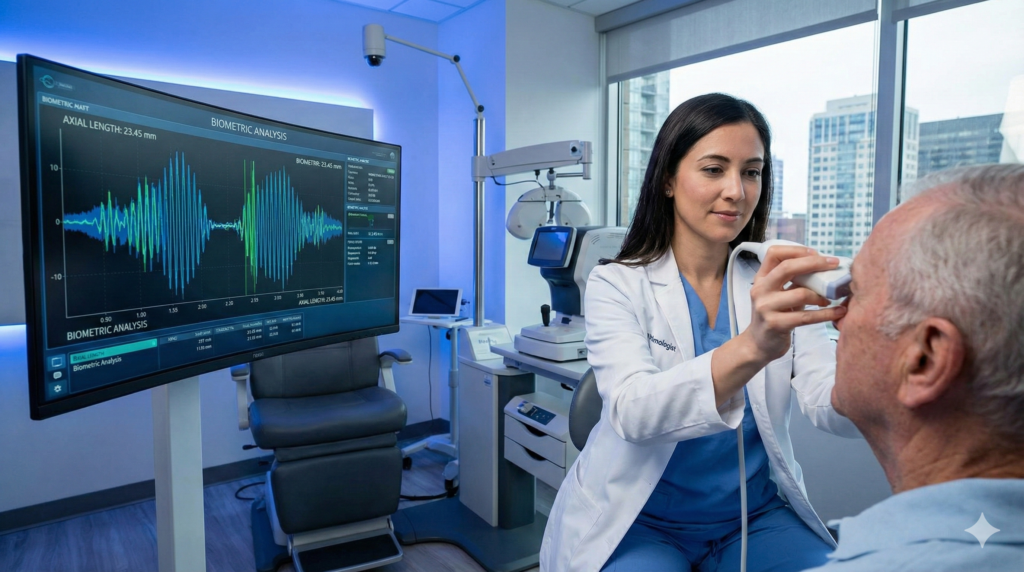
DGH A is an A-scan (amplitude scan) ultrasound biometer engineered for accuracy, consistency, and ease of use. It employs high-frequency ultrasound waves to precisely measure the internal structures of the eye and convert the data into biometric calculations used for clinical and surgical planning.
Unlike older manual measurement tools, DGH A:
- Automates wave detection
- Reduces technician variability
- Provides enhanced waveform clarity
- Integrates with digital imaging and EMR systems
Its core advantage lies in its automated waveform analysis, which reduces user dependence and minimizes human error in measurement interpretation.
===========================================
3. Key Features and Technical Capabilities
===========================================
DGH A stands out for its blend of advanced ultrasound technology and intuitive software. Its features can significantly streamline eye care workflows.
1. High-Precision Axial Length Measurement
DGH A uses:
- High-frequency transducers
- Enhanced signal processing algorithms
- Automated peak detection
This allows clinicians to obtain reliable measurements across a wide variety of eyes, including:
- Dense cataracts
- Post-refractive surgery corneas
- Eyes with irregular anatomy
2. Automated Waveform Analysis
One of DGH A’s signature capabilities is automated waveform interpretation.
Benefits include:
- Reduced operator variability
- Increased repeatability
- Faster scanning
- Clearer identification of ocular boundaries
This enables more consistent results across technicians and appointments.
3. User-Friendly Interface
The system includes:
- Real-time waveform displays
- Intuitive menus
- Guided measurement prompts
- Quick data export options
Technicians appreciate its minimal learning curve, while surgeons value its reliability.
4. Built-In Database and EMR Integration
Modern ophthalmology relies on digital workflow connectivity. DGH A supports:
- EMR integration via HL7
- Cloud-based data storage (in integrated systems)
- Secure data transfer
- Digital patient record synchronization
This ensures that measurements are accessible wherever clinicians need them.
5. Portability and Clinical Flexibility
DGH A is compact and portable, making it ideal for:
- Hospital-based ophthalmology departments
- Ambulatory surgical centers
- Mobile eye clinics
- Tele-opthalmology-enabled practices
The device supports both direct contact and immersion measurement techniques.
===========================================
4. Clinical Applications of DGH A
===========================================
DGH A supports a broad range of clinical and surgical workflows in ophthalmology.
1. Cataract Surgery Planning
IOL power calculation is the single most critical element of cataract surgery.
DGH A improves:
- Measurement accuracy
- Prediction consistency
- IOL formula performance (Haigis, SRK/T, Holladay, etc.)
Patients gain better postoperative outcomes and fewer refractive surprises.
2. Refractive Surgery
For LASIK, PRK, and lens-based procedures, surgeons require precise biometric analysis.
DGH A assists in:
- Screening for abnormal corneal or lens conditions
- Establishing surgical eligibility
- Predicting postoperative refractive targets
- Monitoring outcomes
3. Evaluation of Ocular Pathologies
The ultrasound technology enhances diagnosis in cases such as:
- Axial myopia
- Short axial length (nanophthalmos)
- Posterior staphyloma
- Lens dislocation
- Retinal detachment (assessment adjunct)
These measurements influence long-term disease management.
4. Pediatric Ophthalmology
Children often present with complex measurement challenges.
DGH A:
- Accommodates small eyes
- Reduces acquisition time
- Improves reliability despite movement
Surgeons rely on its accuracy for pediatric cataract and refractive planning.
===========================================
5. Benefits of DGH A in Modern Ophthalmic Practice
===========================================
The impact of DGH A extends beyond its technical features.
1. Higher Measurement Accuracy
The automatically interpreted A-scan waveforms eliminate ambiguity and improve confidence in clinical decisions.
2. Better Clinical Outcomes
Because refractive surgery outcomes depend heavily on accurate measurements, DGH A supports:
- Improved IOL selection
- More predictable visual outcomes
- Enhanced patient satisfaction
3. Workflow Efficiency
DGH A reduces:
- Measurement time
- Technician interventions
- Repeat scans
- Manual entry errors
This improves the consistency of your surgical workups.
4. Supports Digital Transformation in Eye Care
By integrating seamlessly with EMR and imaging systems, DGH A aligns with the broader shift toward:
- Paperless workflows
- Cloud-based reporting
- Data-driven surgical planning
===========================================
6. Integration With Healthcare AI Systems
===========================================
While DGH A itself is an ultrasound measurement tool, its outputs are increasingly used by AI-powered ophthalmic platforms.
AI enhancements include:
- Predictive analytics for patient outcomes
- Automated anomaly detection in biometric patterns
- Enhanced IOL formula performance
- Early detection of corneal instability
As AI becomes more embedded in eye care technology, devices like DGH A will play a foundational role in supplying accurate biometric inputs.
===========================================
7. Challenges and Best Practices
===========================================
1. Operator Training
Despite its automation, correct probe placement and patient cooperation are still essential.
2. Consistency in Measurement Technique
Switching between contact and immersion techniques can create variation.
3. Interpretation of Out-of-Norm Signals
Clinicians should verify measurements that fall outside normal ranges.
4. Integration Readiness
Practices should ensure EMR systems support ultrasound biometry integration.
Conclusion
DGH A has become a critical tool for today’s ophthalmologists, combining the precision of ultrasound biometry with the efficiency of automated waveform analysis. Whether used for cataract surgery planning, refractive procedures, or the evaluation of ocular diseases, DGH A provides clinicians with the accuracy required to make informed, confident decisions. As digital health, AI, and predictive analytics continue transforming eye care, high-quality biometric inputs—like those provided by DGH A—will become even more essential.
By adopting advanced tools such as DGH A, clinics not only improve diagnostic precision but also elevate the overall patient experience, reduce surgical error risk, and align with the future of ophthalmic technology.